Ottobock Continues Growth in Q1 2026 as Prosthetics and Neuro-Orthotics Support Stronger Margins
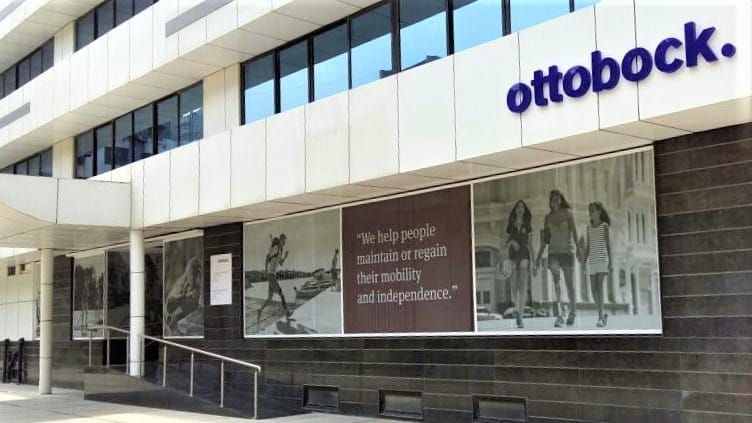
Ottobock has reported continued growth in the first quarter of 2026, with core revenue increasing to €378.4 million and organic core growth reaching 5.1%. The company also delivered a significant margin improvement, with underlying core EBITDA rising 11.8% to €84.3 million and the underlying core EBITDA margin improving to 22.3%.
For India’s orthotics and prosthetics community, the results are important because they show the continued commercial strength of advanced prosthetic, neuro-orthotic and patient-care technologies globally. Ottobock’s performance also reflects a wider industry trend: O&P companies are increasingly combining high-value component innovation with integrated clinical service networks.
A Solid Start to 2026
Ottobock described its first-quarter performance as a solid start to the year. Group core revenue rose by 4.4% to €378.4 million, while total revenue reached €396.0 million, compared with €382.8 million in the same period in 2025.
Underlying net income increased by 13.1% to €22.6 million, while net income rose to €18.8 million from €16.1 million in Q1 2025. Free cash flow also improved strongly, increasing by 32.0% year-on-year to €41.5 million.
Ottobock CEO Oliver Jakobi said the company had met its growth expectations while strengthening profitability and continuing to advance its innovation agenda, including strategic investment in future technologies around the human-machine interface.
Prosthetics and Neuro-Orthotics Remain Key Drivers
The company’s Products and Components business, which includes prosthetics, neuro-orthotics, digital O&P solutions and bionic exoskeletons, generated €213.5 million in revenue during the first quarter. This represented a 3.0% increase compared with Q1 2025 and organic growth of 5.5%.
Ottobock said the growth was mainly driven by sustained positive development in prosthetics and neuro-orthotics, including products such as Genium X4, Kenevo and C-Brace.
This is particularly relevant for O&P professionals in India because it highlights the continued demand for advanced mobility systems that combine engineering, clinical fitting, rehabilitation training and long-term user support.
EMEA and APAC Deliver Growth
Ottobock’s EMEA segment remained the largest contributor to core business revenue. Revenue in the region increased by 8.1% to €282.7 million, supported by solid organic growth in patient care and initial Genium X4 deliveries to Ukraine.
APAC also performed strongly, with segment revenue increasing by 8.3% to €26.7 million. Organic growth in APAC reached 13.9%, with all business units contributing to the positive development. Underlying segment EBITDA in APAC improved by 17.1% to €6.2 million.
The Americas segment declined by 9.8% to €69.0 million, mainly because Q1 2025 had been exceptionally strong, while a temporarily weaker order intake from a large customer and negative US dollar exchange-rate effects also had an impact.
Patient Care Network Continues to Expand
Ottobock’s Patient Care business increased by 6.1% to €164.8 million in Q1 2026. The company attributed this growth to organic expansion and acquisitions, including Matton in Belgium and Northern Prosthetics in Australia.
This part of the business is significant because Ottobock operates a global network of approximately 420 O&P patient-care centres. The model reflects a wider global shift in the sector, where major manufacturers are not only supplying components but also becoming direct providers of clinical O&P services.
For India, where access to modern prosthetic and orthotic care remains uneven, the global expansion of integrated patient-care networks raises important questions about how advanced devices, trained clinicians, service models and long-term follow-up can be scaled more effectively.
Cost Discipline and Procurement Improve Margins
Ottobock’s margin improvement was driven by several factors, including positive product mix effects, procurement initiatives, scaling benefits and cost control, especially in administrative functions.
CFO Dr Arne Kreitz said the quality of earnings improved during the first three months of the year, strengthening the company’s financial flexibility for investment in innovation and growth.
This matters for the wider O&P industry because profitability supports continued investment in research, product development, acquisitions, digital tools and clinical infrastructure.
Guidance for 2026 Confirmed
Following the first-quarter performance, Ottobock confirmed its 2026 guidance. The company expects organic growth in its core business of between 5.0% and 8.0%, with an underlying core EBITDA margin of more than 26.5%.
The company’s quarterly statement also noted continued investment in innovation and highlighted its strategic investment in Blue Arbor Technologies, a company focused on human-machine interface technologies.
Why This Matters for Bharat CPO Readers
Ottobock’s Q1 2026 performance gives India’s O&P sector a useful view of where the global industry is moving. The strongest signals are clear: advanced prosthetics, neuro-orthotics, patient-care services, digital O&P solutions and human-machine interface technologies are becoming increasingly central to growth.
For clinicians, technicians, educators, distributors and rehabilitation providers in India, the results point to several important trends:
- Advanced prosthetic and neuro-orthotic systems remain commercially important.
- Patient-care networks are becoming a major part of global O&P business strategy.
- APAC is showing strong growth potential.
- Digital O&P and human-machine interface technologies are likely to become more important.
- Profitability and scale are helping major companies invest further in innovation.
India’s O&P sector has its own realities, including affordability, geography, workforce development and access gaps. But Ottobock’s results show how the global market is moving toward more integrated, technology-enabled and clinically supported mobility care.
For Bharat CPO, the key question is how India can build its own scalable models: combining advanced technology, trained professionals, local manufacturing, rehabilitation networks and accessible service delivery for patients across the country.