Humotech’s New Approach to Prosthetic Foot Selection Offers Lessons for Indian CPOs
For decades, prosthetic foot selection has depended on a combination of clinical judgement, patient goals, component catalogues, trial fitting, supplier availability and reimbursement constraints. A Pittsburgh-based medtech company, Humotech, is trying to change that process by allowing amputees to test different prosthetic foot behaviours before a final prescription is made.
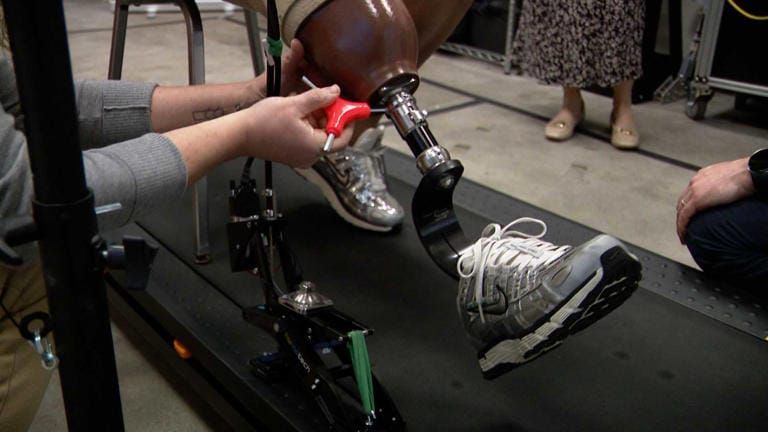
According to the original report, Humotech’s system allows patients to walk on a device that can emulate different commercial prosthetic feet, helping the patient and clinician compare options in real time. Founder Josh Caputo described the approach by comparing it to an eye test, where a patient can try different lenses before choosing the one that works best.
For Bharat CPO, the significance is not simply that another technology company has entered prosthetics. The bigger story is that prosthetic prescription may be moving toward a more personalised, test-before-you-choose model.
Moving Beyond Catalogue-Based Prosthetic Foot Selection
Choosing a prosthetic foot is one of the most important decisions in lower-limb prosthetic care. The foot affects step length, stability, energy return, rollover, confidence on uneven ground and long-term comfort. Yet in many clinical environments, the patient may not be able to compare multiple feet under realistic walking conditions before the final decision is made.
Humotech’s Clinical Caplex system is presented as a tool that makes it easier to trial different prosthetic foot options with patients and support justification using individualised subjective data across foot models, stiffnesses and sizes.
This matters for CPOs because prosthetic foot choice is rarely a simple technical match. Two patients with the same amputation level, body weight and mobility grade may prefer different stiffness, rollover or response. A foot that performs well on paper may not feel right to the person using it every day.
The “Test Drive” Concept
Humotech’s approach is built around the idea of prosthetic foot emulation. Instead of physically ordering and fitting multiple commercial feet, the patient walks with a robotic system that can simulate different foot characteristics. The company’s lower-limb prosthesis platform includes robotically controlled keel and forefoot behaviour, adjustable heel stiffness, adjustable forefoot length and adjustable device mass.
The goal is to give the patient and clinician a more informed basis for selection. In principle, this could reduce guesswork, avoid unnecessary component changes and support better alignment between the prescribed device and the user’s real-world needs.
For Indian CPOs, this is a useful concept even if the technology is not yet widely available in India. It reinforces an important clinical direction: prosthetic selection should become more evidence-informed, patient-specific and outcome-driven.
Why This Is Relevant to India
India’s prosthetics and orthotics sector includes advanced private clinics, charitable services, public hospitals, training institutions, NGOs, component suppliers and government-supported programmes. Across these settings, the challenges of prosthetic foot selection can vary widely.
Common barriers include:
- Limited access to trial components
- Cost constraints for patients and providers
- Delays in ordering and replacement
- Difficulty comparing multiple feet in one clinical session
- Variation in terrain, footwear habits and activity levels
- Limited objective data to support prescription decisions
- Reimbursement or scheme-related restrictions
A system like Humotech’s points toward a future where CPOs could make more informed decisions before committing to a final prosthetic foot. This may be especially valuable in a country where the consequences of a wrong prescription can be significant for both the patient and the service provider.
Patient Preference Should Be Part of the Data
One of the most important lessons from Humotech’s model is that the patient’s experience is not secondary. It is part of the clinical data.
A prosthetic foot may be technically appropriate, but if the user feels unstable, fatigued, slow or uncomfortable, the outcome may be poor. The patient’s perception of rollover, push-off, balance and confidence can help guide better prescription decisions.
For CPOs, this means the future of prosthetic prescription should combine:
- Clinical assessment
- Gait observation
- Alignment review
- Functional testing
- Patient-reported feedback
- Terrain and lifestyle needs
- Component performance data
- Long-term follow-up outcomes
This is particularly important in India, where users may need to walk on mixed terrain, use public transport, stand for long hours, work in physically demanding environments or move between barefoot and shod conditions.
Implications for Indian O&P Education
Humotech’s work also raises questions for Indian O&P education and training. As prosthetic technology becomes more data-driven, CPO students and clinicians will need stronger exposure to biomechanics, gait analysis, patient-reported outcomes and structured component comparison.
The future CPO will not only fit devices. They will increasingly interpret data, compare options, document clinical reasoning and justify prescriptions to patients, funders, hospitals and government programmes.
For teaching institutions in India, technologies like prosthetic emulation should encourage deeper discussion around:
- How prosthetic foot stiffness affects gait
- How activity level should influence component selection
- How to measure patient preference
- How to document prescription justification
- How to evaluate outcomes after delivery
- How to avoid over-prescription and under-prescription
Bharat CPO Perspective
Humotech’s approach is a reminder that the prosthetic foot is not a commodity item. It is a functional interface between the patient and the ground. The right foot can improve confidence, stability and daily mobility. The wrong foot can create discomfort, fatigue, poor gait patterns and dissatisfaction.
For India, the most immediate value of this story may be conceptual rather than technological. Not every clinic will have access to a robotic prosthetic foot emulator. But every clinic can move toward more structured, patient-centred decision-making.
Indian CPOs can take three lessons from the Humotech model:
- First, prosthetic prescription should be tested as much as possible, not guessed.
- Second, patient feedback should be recorded and treated as clinical evidence.
- Third, component selection should be linked to real mobility goals, not only catalogue categories.
As India’s O&P sector grows, better prosthetic outcomes will depend on more than product availability. They will depend on better prescription systems, better clinical reasoning and better tools for matching the right device to the right person.
Humotech’s work shows where the field may be heading: toward a future where amputees can test, compare and choose with greater confidence, and where CPOs have stronger data to support every prescription.